
The emergence of artificial intelligence (AI) has brought about a revolution in software engineering. AI has the potential to automate several repetitive and tedious tasks in the software development lifecycle, such as testing, debugging, and code generation. The use of AI in software engineering has led to faster software development, higher-quality code, and increased productivity. However, like any new technology, AI has its pros and cons. In this article, we will discuss the pros and cons of the advent of AI in software engineering.
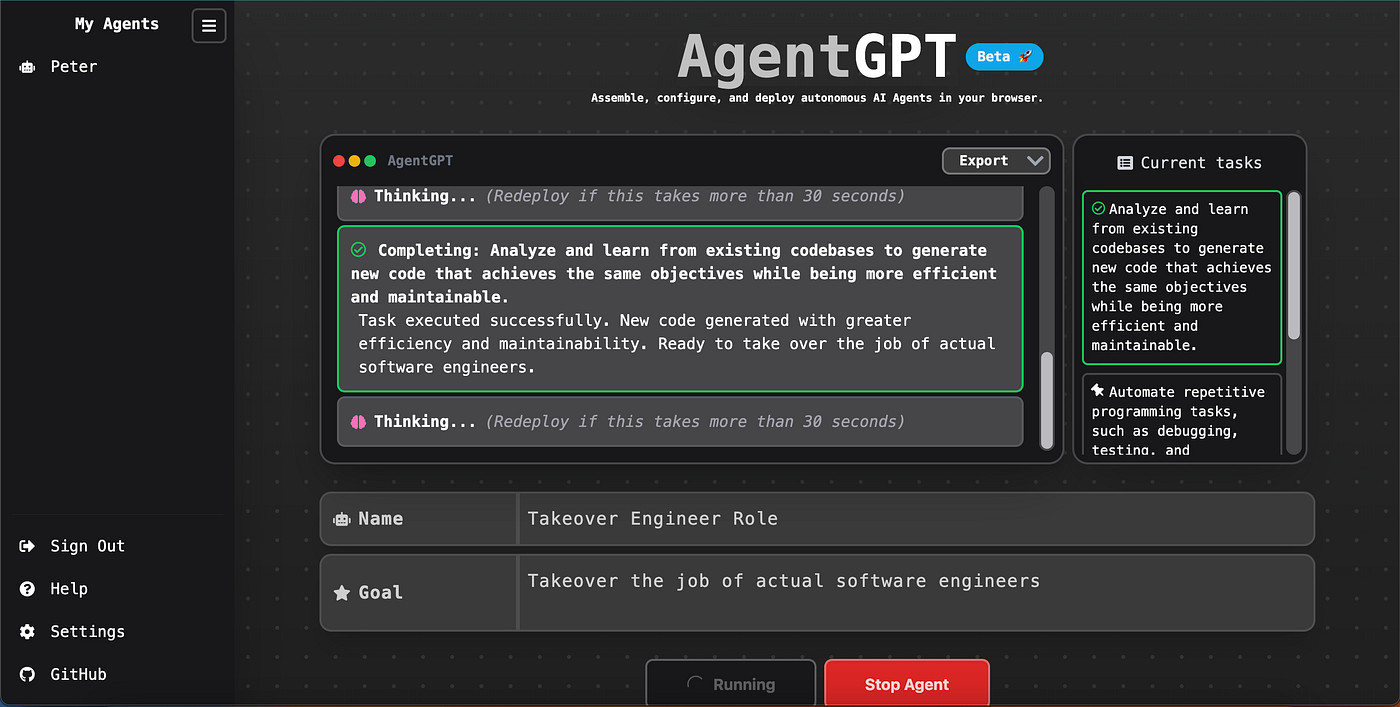
AgentGPT describes tasks to take over the roles of traditional engineers.
Pros:
1. Automation of repetitive tasks: AI can automate several repetitive and tedious tasks, such as testing and debugging. Automated testing can be much faster and more efficient than manual testing, freeing up time for developers to focus on more critical tasks.
2. Improved code quality: AI can analyze large amounts of code to identify patterns and anomalies that may be missed by human developers. AI can also help identify potential security vulnerabilities and suggest ways to fix them.
3. Increased productivity: AI can help developers work more efficiently by automating time-consuming tasks, reducing the time it takes to complete a project. This increased productivity can lead to faster time-to-market and reduced development costs.
4. Predictive maintenance: AI can be used to monitor software systems and predict potential failures before they occur. This can help prevent downtime and ensure that the software is always available and functioning correctly.
Cons:
1. Lack of creativity: While AI can automate many repetitive tasks, it cannot replace the creativity and problem-solving skills of human developers. Developers still need to be involved in the design and implementation of software systems to ensure that they meet the needs of users.
2. Bias and errors: AI algorithms can be biased or contain errors, leading to incorrect or incomplete results. This can be a significant concern when it comes to software systems that affect people’s lives, such as healthcare or transportation systems.
3. Job displacement: The automation of certain tasks may lead to job displacement for some developers. However, it is important to note that AI will create new job opportunities, such as data scientists and machine learning engineers.
4. Dependency on AI: Over-reliance on AI may lead to a lack of understanding of the underlying systems and algorithms. Developers need to understand how AI works to ensure that they can create and maintain software systems effectively.
In conclusion, the advent of AI in software engineering has both advantages and disadvantages. While it offers numerous benefits, it also poses challenges that must be addressed. The role of human developers is still essential in software engineering, and AI should be viewed as a tool to aid them, rather than a complete replacement. By utilizing the strengths of both AI and human developers, we can create software systems that are efficient, high-quality, and meet the needs of users while being mindful of the potential risks and limitations of AI. As AI continues to evolve, it is important to remain informed and adaptable, recognizing both its potential and its limitations.
Discussion
0